
Interpreter cancellation policy: a template for agencies

On this page
Every interpreting agency has the same story. A client cancels a hospital appointment at 7.40 the night before. The interpreter has already turned down another booking for that slot, and arranged childcare. Who pays?
If the answer depends on who picks up the phone, you don't have a cancellation policy, you have a negotiation. Interpreters notice, clients notice, and the agency usually ends up absorbing the cost.
A written policy fixes that. It sets expectations before the first booking, protects the interpreters who keep your agency running, and gives your coordinators something to point to instead of an argument. Below is what it needs to cover, a template you can adapt, and how to apply it without losing clients.
What a cancellation policy needs to cover
- Notice periods: how much notice counts as "in time", and the fee for each window inside that.
- What is charged: a percentage of the booked fee, the minimum charge, travel already incurred.
- The interpreter's pay: what they receive when a client cancels late. If you charge the client, the interpreter should normally see some of it.
- No-shows on either side: how long the interpreter waits, what's charged, and what happens if the interpreter doesn't arrive.
- Changes: when moving the time or place counts as a cancellation.
- Remote sessions: whether video and phone bookings follow the same rules.
- Exceptions: what you'll waive, such as a documented emergency.
- Agreement: how and when the client accepts it.
A template you can adapt
The figures in square brackets are examples. Choose your own, and have your terms reviewed by a solicitor before you rely on them.
Cancellation and no-show policy
1. Scope. This policy applies to all interpreting bookings, whether face-to-face, by telephone or by video, made with [Agency name].
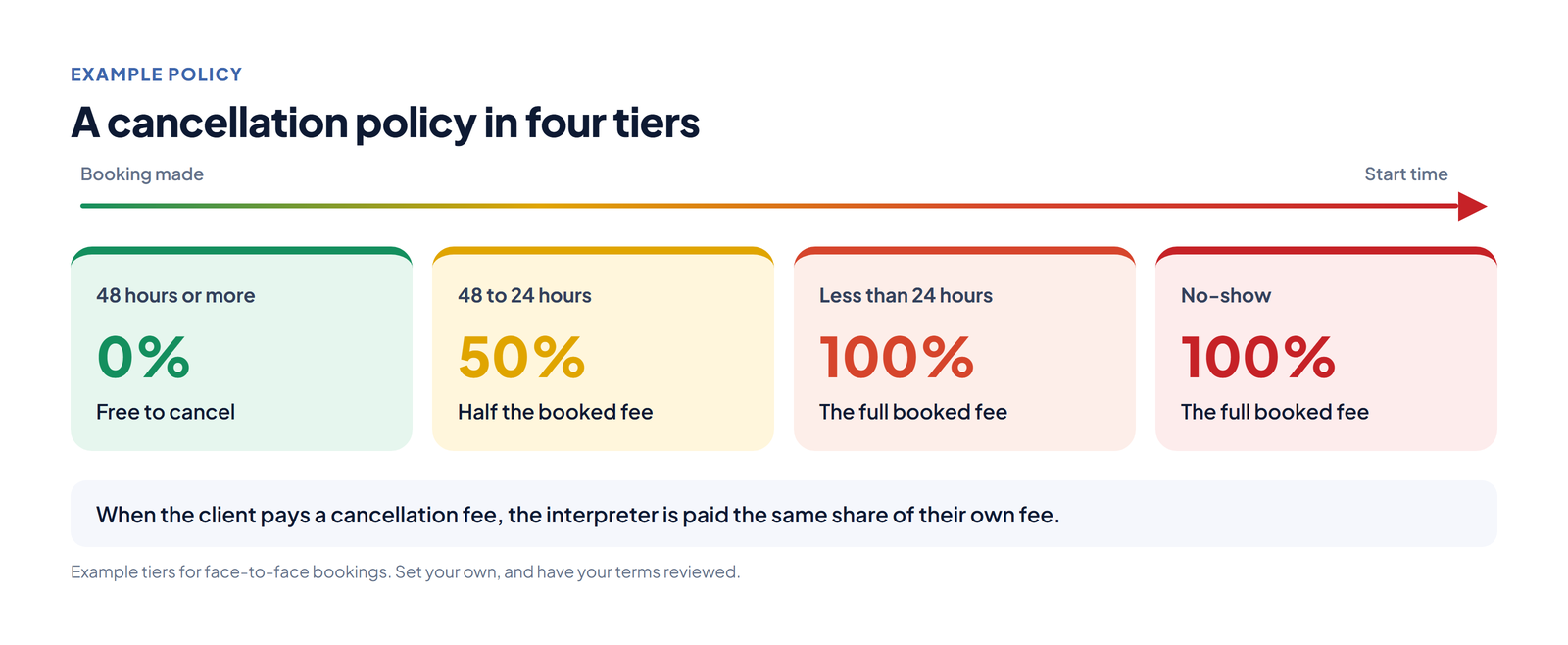
2. Cancelling a booking. You can cancel a booking free of charge with at least [48 hours'] notice before the booked start time. For cancellations with less notice:
- between [48 and 24 hours] before the start time, we charge [50%] of the booked fee;
- less than [24 hours] before the start time, we charge [100%] of the booked fee.
The booked fee includes the minimum booking length of [2 hours] for face-to-face assignments and [30 minutes] for telephone and video assignments.
3. Travel. If the interpreter has already incurred travel costs when you cancel, these are charged in addition.
4. Changes. Moving a booking to a different day, or by more than [2 hours] on the same day, is treated as a cancellation and a new booking. We'll always try to keep the same interpreter.
5. No-shows. If the interpreter arrives or connects on time and the session doesn't take place within [30 minutes] of the start time, the booking is charged in full.
6. If we cancel or the interpreter doesn't attend. If we can't provide an interpreter, or the interpreter doesn't attend, you won't be charged, and we'll offer a replacement as quickly as we can.
7. Exceptions. We may waive a fee in exceptional circumstances, such as a documented medical emergency. Waivers are at our discretion and don't change this policy for future bookings.
8. Acceptance. This policy forms part of our terms. By confirming a booking, you accept it.
Paying interpreters when a client cancels late
Interpreters block out time, turn down other work and often travel. A late cancellation costs them real money, and the way you treat them when it happens decides whether your best interpreters keep saying yes to you.
A simple, fair rule: when the client pays a cancellation fee, the interpreter receives the same share of their own fee. If the client pays 50%, the interpreter is paid 50%. Say so in your terms with interpreters, too, so they never have to ask.
Your system should record the decision on the booking itself, so the client invoice and the interpreter's payment both follow from it. In LinguisTriks, a cancelled booking can keep its charges for the client, and you decide separately whether the interpreter is still paid. Nobody has to remember it at the end of the month.
No-shows: on both sides
When the client doesn't turn up, the interpreter should tell you straight away, wait for the agreed time, and record when they arrived and who they spoke to. That record is what makes a no-show charge stick if the client disputes it.
When the interpreter doesn't turn up, the client shouldn't pay, and you need to know why. Keep a log. One missed booking can have a good reason; a pattern needs a conversation.
Reminders prevent a surprising number of no-shows on both sides. An email and SMS the day before, with the time, address and contact name, catches the "I thought it was next week" mistakes before they cost anyone money.
Remote sessions
Video and telephone bookings are easier to rearrange, so some agencies set shorter notice periods for them, for example 24 hours instead of 48, and a shorter minimum. Whatever you choose, write it down separately. "Same as face-to-face" is the usual source of disputes, because the client assumes a phone call is cheaper to cancel.
If you run sessions through a meeting link, make sure a cancellation also cancels the invite, so nobody joins an empty room.
How to apply it without losing clients
Agree it before the first booking. Put it in your terms, link it in your booking confirmations and have new clients accept it when they register. A policy that appears for the first time on an invoice will be disputed.
Repeat it in every confirmation. One line is enough: "Cancellations with less than 48 hours' notice are charged at 50%." It costs nothing and removes the surprise.
Apply it every time, and record exceptions. If you waive a fee as goodwill, note it on the booking and tell the client it's a one-off. Inconsistent enforcement teaches clients that the policy is optional.
Make the late cancellation visible. A cancellation fee line on the invoice, with the time the cancellation arrived, answers most queries before they're raised.
Talk to your biggest clients first. If a public sector client has its own cancellation terms in a framework contract, those terms usually take precedence. Align your interpreter pay with them rather than discovering the gap later.
Let the system do the remembering
Most cancellation disputes come from information that lived in someone's head: when the client called, whether the interpreter had travelled, what was agreed. Record it on the booking at the moment it happens, keep the client charge and the interpreter's pay with it, and send reminders automatically. Then the policy runs itself.
That's how interpreting bookings in LinguisTriks work: bookings in their own time zone, email and SMS reminders, cancellations with or without charges, and the interpreter's pay decided on the same record. Start a free trial to try it with your own bookings.
Frequently asked questions
How much notice should a client give to cancel an interpreter?
Many agencies ask for 48 hours' notice for face-to-face bookings and charge a share of the fee for later cancellations. Choose notice periods that reflect how far your interpreters travel and how easily they can fill the slot, and put them in your terms.
Should interpreters be paid when a client cancels late?
Yes. If the client pays a cancellation fee, a fair rule is to pay the interpreter the same share of their own fee, and to say so in your terms with interpreters.
What counts as a no-show?
Agree a waiting time in your terms, such as 30 minutes after the start time. If the interpreter is there on time and the session doesn't happen within it, the booking is charged in full; the interpreter should record when they arrived and who they spoke to.
Do the same rules apply to video and phone interpreting?
Not necessarily. Remote bookings are easier to rearrange, so many agencies use shorter notice periods and minimums for them. Write the remote rules down separately so clients aren't surprised.
Is a cancellation fee enforceable?
If it's agreed in your terms before the booking, it forms part of the contract, but whether a particular fee can be enforced depends on the contract and the law where you operate. Have your terms reviewed by a solicitor.
Related articles
TMS vs TBMS vs CAT tool: which software does a translation agency need?
A CAT tool helps a linguist translate the text, using translation memory and a termbase. A translation management system (TMS) runs the translation workflow: files, tasks, connectors and automation. A translation business management system (TBMS) runs the agency itself: clients, quotes, jobs, freelancers, invoices and payments. Most agencies need a CAT tool for their linguists and a TBMS for the business; a TMS earns its place when clients send a constant stream of content to localise.
Read article
How to price translation services: a margin model for agencies
Price translation from what a job really costs you - the translator, revision, project management time, certification and payment fees - then add the margin you need and express it as a rate the client understands. Charge per word for most documents, per document for certificates and short standard documents, per hour for editing and DTP, and always set a minimum charge.
Read article
Interpreter Scheduling Software: A Buyer's Checklist for Agencies
Good interpreter scheduling software books onsite, phone and video jobs in one place and fills them quickly with email and SMS offers. It gives clients and linguists self-service portals and turns completed jobs into invoices and payouts without re-keying. It also keeps your data secure and auditable. This checklist shows what to test before you buy.
Read article