

How to start an interpreting agency in the UK: a practical guide for 2026

On this page
Most interpreting agencies in the UK start in one of two ways. An experienced interpreter gets more requests than they can take and starts passing work to colleagues, or a translation agency keeps being asked for interpreters and decides to supply them properly.
Either way, interpreting is a different business from translation. The work happens at a set time and place, often at short notice, and a missed booking can mean a cancelled hospital appointment or an adjourned hearing. Reliability is the product.
This guide covers what you need to get right before your first booking: the rules that apply, setting up the business, building an interpreter network, pricing, and winning clients.
Decide what kind of agency you'll be
Be specific about three things before anything else, because they shape everything that follows:
- Services: face-to-face, telephone, video, or all three. Telephone and video can be delivered from anywhere; face-to-face needs interpreters near your clients.
- Languages: the languages your local area and your target clients actually need, not the longest list you can claim. Ten languages you can always cover beat fifty you can't.
- Sectors: healthcare, legal, local government, education, social care or private business. Each has its own expectations about qualifications, vetting and paperwork.
The rules that apply to interpreting agencies
If you introduce interpreters to clients, or supply them to work for clients, you are very likely covered by the Employment Agencies Act 1973 and the Conduct of Employment Agencies and Employment Businesses Regulations 2003. The government's guidance for providers of interpreting services says so directly, and it applies across private, public and not-for-profit work.
The guidance distinguishes two models:
- An employment agency introduces an interpreter to a client so the client can employ them directly, and the client pays the interpreter.
- An employment business has a contract with the interpreter and a contract with the client, supplies the interpreter to work under the client's direction, and pays the interpreter.
Most interpreting agencies work the second way: you take the booking, send the interpreter, invoice the client and pay the interpreter. Which model you use affects which parts of the regulations apply, so read the guidance carefully and take advice if you're unsure.
The rules are enforced by the Fair Work Agency, which replaced the Employment Agency Standards Inspectorate in April 2026 and regulates the private recruitment sector in England, Wales and Scotland. The guidance warns that breaching the rules can lead to prosecution and a fine, and in serious cases to an order banning a person from running an agency for up to ten years. Northern Ireland has its own rules.
In practice, compliance comes down to habits you'd want anyway: clear written terms with clients and with interpreters, agreed before work starts, and honest records of what was booked, delivered and paid.
Set up the business
The practical set-up is the same as for most service businesses:
- Choose a legal structure. Many agencies start as sole traders and become limited companies as they grow. Talk to an accountant about which suits you.
- Register with HMRC, and with Companies House if you form a company.
- Open a business bank account, so client payments and interpreter payments never mix with personal money.
- Pay the data protection fee. You'll hold personal details about clients, interpreters and often the people being interpreted for. The ICO says that organisations, including sole traders, that use personal information need to pay a data protection fee unless they are exempt.
- Get insured. Professional indemnity and public liability insurance are the usual starting points for an interpreting agency, and employer's liability insurance is a legal requirement once you employ staff. A broker who knows the language sector will save you time.
Build your interpreter network
Your interpreters are your product, so recruit for reliability as much as for languages.
Qualifications. Requirements depend on the client and the sector. Public service clients often ask for the Diploma in Public Service Interpreting (DPSI) or registration with the National Register of Public Service Interpreters (NRPSI), the UK's independent voluntary regulator of public service interpreters. NRPSI registration isn't compulsory, but registered interpreters have met its standards and follow its code of conduct, which many clients value.
Vetting. Check identity, qualifications and references for every interpreter. If they'll work with children or vulnerable adults, many clients will expect a DBS check.
Terms. Agree in writing how interpreters are engaged, what they're paid (including minimum hours, travel and cancellations) and how and when they're paid. Interpreters choose which agencies to say yes to, and agencies that pay accurately and on time get the first yes.
Depth. For each language you offer, aim for several interpreters, not one. One interpreter per language is one sick day away from a missed booking.
Set your rates and terms
Interpreting is usually charged by time, with a minimum booking length:
- Face-to-face: an hourly rate with a minimum (two hours is common), plus travel time or mileage, agreed up front.
- Telephone and video: per minute or per session, with a shorter minimum.
- Urgent and out-of-hours bookings: a clear uplift, defined in your terms.
- Cancellations: notice periods and fees, written down before the first booking. Our interpreter cancellation policy template is a starting point.
Work out your rates from what you pay interpreters, what each booking costs you to arrange, and the margin you need, not just from competitors' price lists.
Win your first clients
Private clients such as solicitors, healthcare providers, employers and insurers often decide on responsiveness: who answers the phone, who confirms quickly, who never misses a booking. Start with organisations near your interpreters, and make booking with you easy.
Public sector clients such as NHS trusts, councils and courts usually buy through contracts and frameworks. Contracts are advertised on the government's Find a Tender service and on regional portals. Tenders reward evidence: your vetting process, how you cover urgent bookings, complaint handling and data protection. Build those processes from day one, and you'll be ready when a tender appears.
Run bookings without chaos
The day-to-day work is a loop: a request comes in, you find an interpreter, confirm the details, send reminders, collect the timesheet, invoice the client and pay the interpreter. At ten bookings a week you can run that from email and a spreadsheet. At fifty, things start slipping: a booking nobody confirmed, an interpreter paid twice, an invoice never sent.
Set up a system before you need it. Look for one that keeps every booking in its own time zone, sends a job to several interpreters at once by email and SMS, lets them accept with one tap, sends reminders automatically, and connects the booking to the invoice and the interpreter's payment. Our interpreter scheduling software checklist goes through what to look for, and LinguisTriks for interpreting agencies does all of it in one place.
A start-up checklist
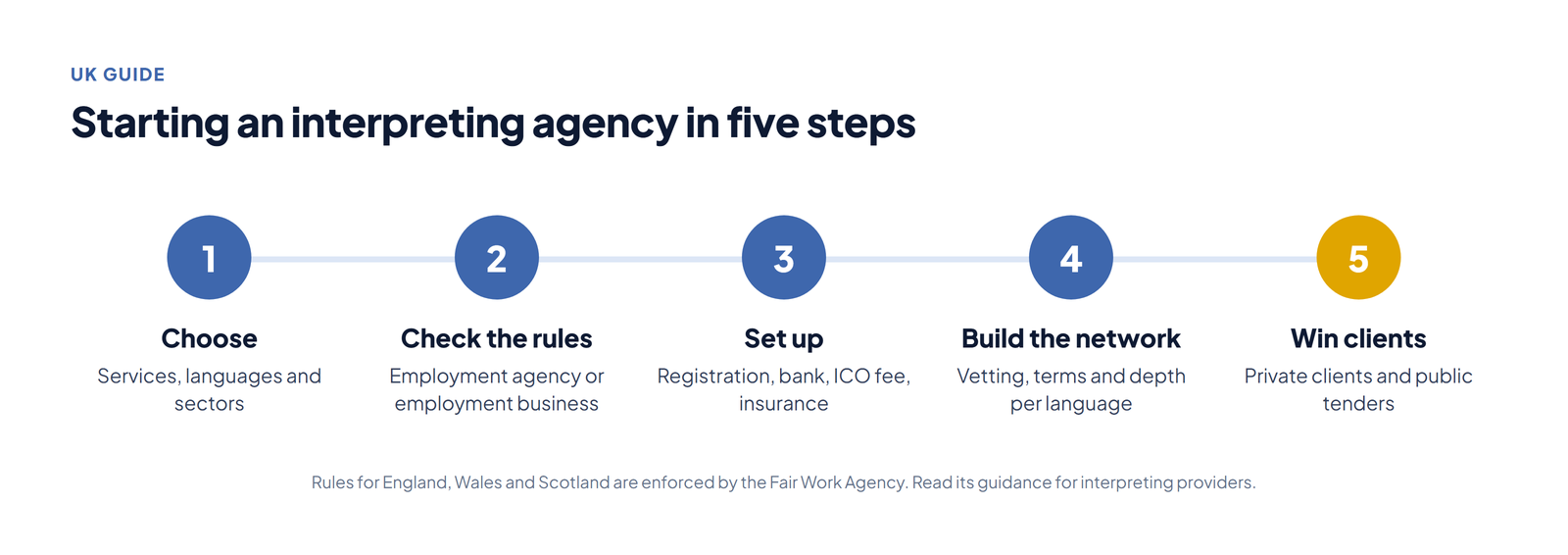
- Services, languages and sectors decided
- Fair Work Agency guidance for interpreting providers read, and your model decided
- Business registered, bank account opened
- ICO data protection fee paid
- Professional indemnity and public liability insurance in place
- Written terms for clients and for interpreters, including cancellations
- Interpreter vetting process: identity, qualifications, references, DBS where needed
- At least two interpreters for each language you offer
- Rates, minimums, travel and urgent-booking uplifts set
- A booking system that covers bookings, reminders, timesheets, invoicing and interpreter pay
None of this is complicated on its own. The agencies that grow are the ones that get these basics right early and never miss a booking.
Frequently asked questions
Do I need a licence to run an interpreting agency in the UK?
There's no general licence to apply for, but if you introduce or supply interpreters to clients you're very likely covered by the Employment Agencies Act 1973 and the Conduct Regulations 2003, which the Fair Work Agency enforces in England, Wales and Scotland.
Is NRPSI registration mandatory for interpreters?
No. NRPSI is an independent voluntary regulator, but many public service clients prefer or require interpreters on its register.
What qualifications should interpreters have?
It depends on the client and sector. Public service work often asks for the Diploma in Public Service Interpreting (DPSI) or NRPSI registration, and healthcare and legal clients usually set their own requirements.
Should I start as a sole trader or a limited company?
Many agencies start as sole traders and form a company as they grow. The right choice depends on liability, tax and the clients you want to win, so take advice from an accountant.
How do interpreting agencies find clients?
Private clients such as solicitors and healthcare providers choose agencies that respond quickly and never miss a booking. Public bodies advertise contracts on the government's Find a Tender service and regional portals, where evidence of vetting and reliability wins.
Related articles

Interpreter cancellation policy: a template for agencies
A good interpreter cancellation policy sets notice periods and fees (for example, free with 48 hours' notice, half the fee inside 48 hours and the full fee inside 24 hours), says what the interpreter is paid, covers no-shows on both sides and remote sessions, and is agreed in writing before the first booking. The template below is a starting point to adapt with your own terms and legal advice.
Read article
Certified translation statement: templates for the UK and USCIS
A certified translation statement is a signed declaration that a translation is complete and accurate. In the UK, CIOL advises that it states the translation is true and accurate and gives the date and the name and contact details of the translator or company representative. For USCIS, the translator must certify that the translation is complete and accurate and that they are competent to translate into English. Templates for both are below.
Read articleHow to Fill Last-Minute Interpreter Requests: A Dispatch Workflow for Agencies
To fill a last-minute interpreter request, triage it in minutes, shortlist only interpreters who are qualified and can realistically get there, and send one clear offer to that whole group at once by SMS and email. Confirm the first suitable acceptance, brief the interpreter, and keep a remote backup ready in case of a no-show.
Read article