

Certified translation statement: templates for the UK and USCIS
On this page
- What is a certified translation statement?
- What the statement needs in the UK
- What USCIS requires
- Template: certified translation statement for the UK
- Template: translator's certification for USCIS
- The details that get translations rejected
- Certified, notarised and sworn translations
- Producing certificates without retyping
A certified translation is rarely rejected because of the translation itself. It's rejected because the statement on the front is missing something: no date, no contact details, a signature from the wrong person, or wording that doesn't say what the receiving organisation needs.
This guide covers what the statement needs to say in the UK and for US immigration (USCIS), gives you a template for each, and lists the details that most often get certified translations sent back.
What is a certified translation statement?
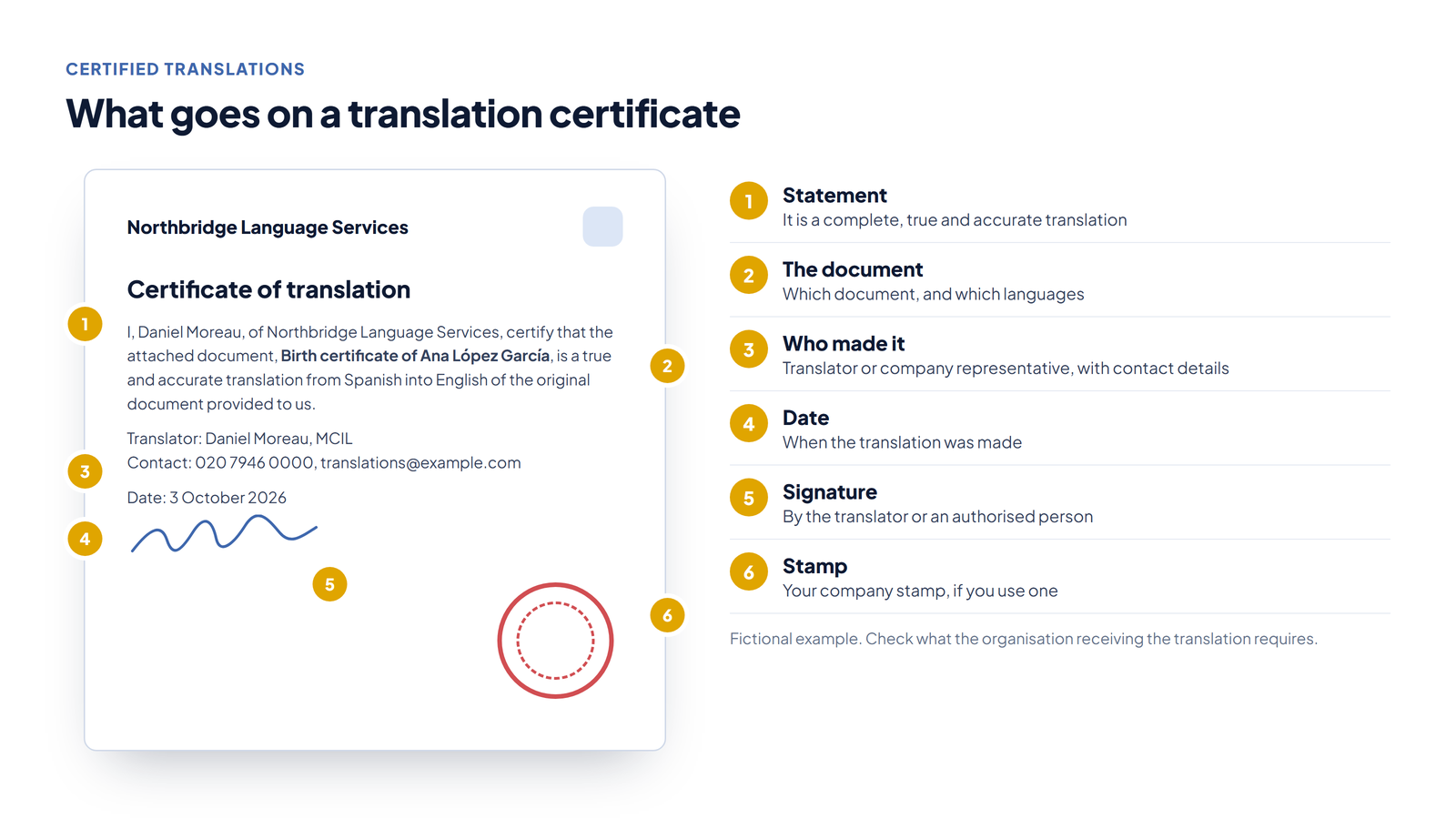
It's a short, signed declaration attached to a translation, confirming that the translation is a complete and accurate rendering of the original document. It identifies the document and the languages, says who made the translation and when, and is signed by the translator or by someone authorised by the translation company.
The translation itself doesn't change. The statement is what turns it into a certified translation.
What the statement needs in the UK
There's no single legal definition of a certified translation in the UK. The Chartered Institute of Linguists advises that a certified translation should come with a certificate that includes:
- a statement that it is a true and accurate translation of the original document;
- the date of the translation;
- the name and contact details of the translator, or of a representative of the translation company.
CIOL also recommends using a qualified translator or translation company that belongs to a recognised professional body, such as CIOL, the Institute of Translation and Interpreting (ITI) or the Association of Translation Companies (ATC).
Some organisations ask for more. UK Visas and Immigration, for example, may want the translator's signature and credentials as well, so always check the current guidance for the specific application before you issue the certificate.
What USCIS requires
For US immigration filings, the requirement is set out in the regulations. Under 8 CFR 103.2(b)(3), any document containing a foreign language submitted to USCIS "shall be accompanied by a full English language translation which the translator has certified as complete and accurate, and by the translator's certification that he or she is competent to translate from the foreign language into English."
That's two separate statements, and both need to be there:
- the translation is complete and accurate;
- the translator is competent to translate from that language into English.
Notice what the regulation doesn't ask for: it says nothing about notarisation. And because it talks about the translator certifying, the statement should come from the person who did the translation.
Template: certified translation statement for the UK
Adapt the wording in square brackets. Keep the statement on your letterhead, and attach it to the translation so the two can't be separated.
Certificate of translation
I, [full name], of [translation company name and address], certify that the attached document, [document title, for example "Birth certificate of Ana López García"], is a true and accurate translation from [source language] into [target language] of the original document provided to us.
The translation consists of [number] pages, including this certificate.
Translator / company representative: [full name]
Professional body membership: [for example, MCIL, MITI, or ATC member number]
Contact details: [telephone and email]
Signed: ____________________
Date: [date of the translation]
[Company stamp]
Template: translator's certification for USCIS
Certification of translation
I, [full name of the translator], certify that I am competent to translate from [source language] into English, and that the attached English translation of [document title] is complete and accurate to the best of my knowledge and ability.
Name: [full name]
Address: [address]
Signature: ____________________
Date: [date]
Both templates are deliberately short. Clear wording that covers every required element is more useful than paragraphs of legal-sounding text.
The details that get translations rejected
Most rejections come from a short list of avoidable mistakes:
- No date, or a date that doesn't match when the translation was made.
- No contact details for the translator or company.
- An unsigned certificate, or one signed by someone who didn't make or check the translation.
- The document isn't identified. "The attached document" on its own isn't enough when the client sends five.
- A partial translation that doesn't say so. If anything is left untranslated, such as an illegible stamp, the translation should say so in a translator's note.
- Names that don't match. Spell names exactly as they appear in the original document and the client's passport, and keep the order.
- Stamps and handwriting ignored. Seals, stamps and handwritten notes are part of the document and need translating or describing.
- The certificate and the translation are separate files. Combine them into one PDF, or one stapled set, so pages can't go missing.
- Pages missing. Number the pages and state the total on the certificate.
Certified, notarised and sworn translations
The three terms get mixed up, and clients often ask for the wrong one.
- Certified: the translator or translation company signs a statement that the translation is complete and accurate. This is what most UK organisations and USCIS ask for.
- Notarised: a notary also certifies the signature on that statement. It's only needed when the receiving organisation specifically asks for it, and the notary doesn't check the translation itself.
- Sworn: in some countries, translators are officially appointed, often by a court, to produce sworn translations. The UK and the US don't have that system, so check exactly what the receiving organisation means before you agree to provide one.
Producing certificates without retyping
If you issue certificates by copying the last Word file and editing the name, sooner or later a client receives a certificate with someone else's details on it. Generate it from the job instead: the client, the document, the languages, your reference, the date, your signature and your stamp, filled in automatically from one template you control.
In LinguisTriks, certificates and declarations are generated from your own template on the job, and the certificate, the translation and the source can be merged into one PDF ready to email or post. See how translation projects work, or start a free trial and issue your next certificate in a few clicks.
Frequently asked questions
What is a certified translation statement?
A short signed declaration attached to a translation, confirming it is a complete and accurate translation of the original. It identifies the document and the languages, says who made the translation and when, and is signed by the translator or an authorised person.
Does USCIS require a notarised translation?
The regulation, 8 CFR 103.2(b)(3), asks for the translator's certification that the translation is complete and accurate and that they are competent to translate into English. It doesn't mention notarisation.
Who can certify a translation in the UK?
There's no single legal definition of a certified translation in the UK. CIOL recommends a qualified translator or translation company that belongs to a recognised professional body, such as CIOL, ITI or the ATC.
Can a translation company sign the certificate instead of the translator?
CIOL's UK guidance allows the name and contact details of a representative of the translation company. For USCIS, the regulation refers to the translator's own certification, so the person who translated the document should sign.
What's the difference between certified and notarised translations?
A certified translation carries the translator's or company's signed statement of accuracy. A notarised translation adds a notary's certification of the signature on that statement; the notary doesn't check the translation itself.
Related articles

How to price translation services: a margin model for agencies
Price translation from what a job really costs you - the translator, revision, project management time, certification and payment fees - then add the margin you need and express it as a rate the client understands. Charge per word for most documents, per document for certificates and short standard documents, per hour for editing and DTP, and always set a minimum charge.
Read articleHow to Fill Last-Minute Interpreter Requests: A Dispatch Workflow for Agencies
To fill a last-minute interpreter request, triage it in minutes, shortlist only interpreters who are qualified and can realistically get there, and send one clear offer to that whole group at once by SMS and email. Confirm the first suitable acceptance, brief the interpreter, and keep a remote backup ready in case of a no-show.
Read article
How to pay freelance translators and interpreters without paying twice
Pay freelance linguists from an approved list, not from your inbox: collect complete bank or PayPal details up front, approve each payment against delivered work, pay in a regular run through a method that suits the linguist's country, and lock each payment once it's sent so a retry can never pay it twice. Then tell the linguist and reconcile.
Read article