

How to price translation services: a margin model for agencies
On this page
- The four ways to charge for translation
- Build the price from the cost, not from a rate card
- Repetitions and translation memory matches
- Minimum charges and urgent work
- Pricing AI-assisted translation honestly
- Certified translations
- Put the price in front of the client properly
- Review your prices every quarter
Most agencies set their first prices by looking at what everyone else charges and shaving a little off. It feels safe. It also means your prices have nothing to do with your costs, and you only find out which jobs lose money when the bank balance tells you.
There's a better way, and it isn't complicated: work out what a job actually costs you, add the margin you need, then decide how to express that as a rate the client understands. This guide walks through it with a worked example.
The four ways to charge for translation
Per word is the default for most documents. It's easy to explain, scales with the work and is simple to compare. Quote on the source word count whenever you can, because you know it before you start; a target-word price leaves the client guessing until the job is done.
Per page or per document suits short, standard documents such as birth certificates, driving licences and degree certificates. A one-page certificate can take as long to lay out, check and certify as a three-page letter, and a fixed price per document reflects that better than a word rate.
Per hour fits work that isn't about volume: proofreading a client's own translation, desktop publishing, transcreation of a slogan, or terminology work.
A fixed fee works for projects with a clear scope, such as a website translated once into five languages.
Most agencies use all four. The mistake isn't choosing the wrong one; it's having no minimum charge underneath them.
Build the price from the cost, not from a rate card
A translation price has more in it than the translator's fee. Write down every cost a typical job carries:
- The translator, usually paid per word.
- Revision by a second linguist, if the job includes it. For certified, legal and medical work it should.
- Project management time: quoting, finding the linguist, checking, delivering, invoicing.
- Certification and admin: the certificate, stamping, scanning, posting.
- Payment fees: card or PayPal fees on the client's side, transfer fees on the linguist's.
- Tools and AI: your share of CAT licences, software, and the cost of any AI first draft.
- Overheads: everything else that keeps the lights on.
Here's a worked example. The figures are made up to show the method, so use your own.
| A 2,000-word legal contract, Spanish to English | Cost |
|---|---|
| Translator at £0.08 a word | £160.00 |
| Reviser at £0.03 a word | £60.00 |
| Project management, 45 minutes at £30 an hour | £22.50 |
| Admin and delivery | £10.00 |
| Payment fees, about 2% of the price | £8.00 |
| Direct cost | £260.50 |
If you want a 35% gross margin, divide the direct cost by 0.65: £260.50 / 0.65 = £400.77. Round it to £400 and you're charging £0.20 a word for this kind of work.
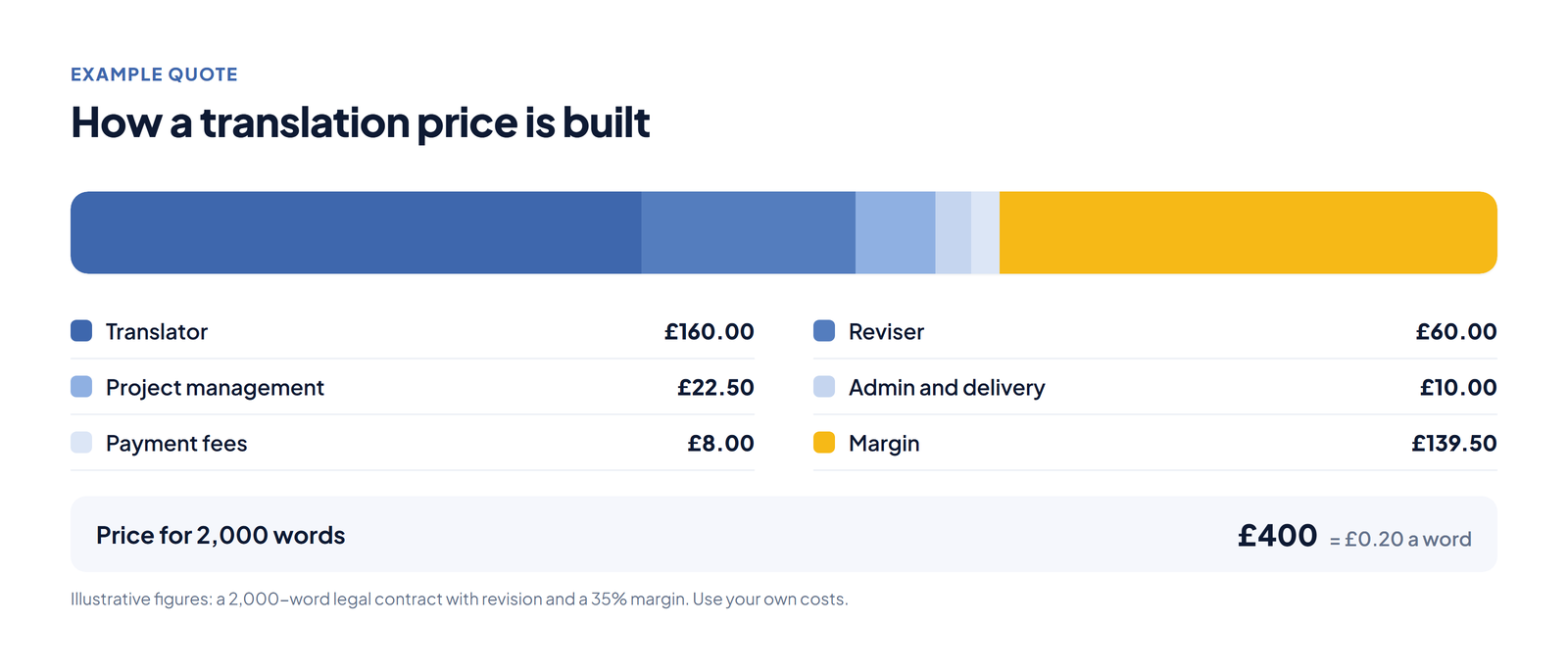
Two things fall out of doing this once. You'll see that the translator is only part of the cost on small jobs, and you'll see why a "cheap" rate on a 300-word job can lose money once project management time is counted.
Repetitions and translation memory matches
On longer documents, much of the text may be repeated or already in your translation memory. Clients increasingly expect a discount for that, and it's fair: a 100% match takes far less effort than a new sentence.
A common way to handle it is a match grid that pays a percentage of the full rate for each band. The percentages below are an example of how agencies set them up, not a standard:
| Match band | Example share of the full rate |
|---|---|
| Repetitions and 100% matches | 25-30% |
| 95-99% fuzzy matches | 50% |
| 85-94% fuzzy matches | 70% |
| 75-84% fuzzy matches | 85% |
| No match | 100% |
If you discount clients this way, pay linguists on the same grid, or your margin quietly disappears on exactly the jobs that should be the most profitable. And count the words with the match bands before you quote, not after the job is assigned. In LinguisTriks the word count on a quote's files shows the repetitions and memory matches in bands like these, without opening a CAT tool.
Minimum charges and urgent work
Every agency needs a minimum charge. Without one, a 40-word email costs you more in project management time than it brings in. Set the minimum at the price that covers the smallest realistic job: the linguist's own minimum, the project management time and your margin. Show it on every quote, so it's never a surprise.
Urgent work deserves its own rate, because it costs more: it means asking a linguist to drop other work, paying them more, and checking more carefully. State what "urgent" means (same day, next working day) and what the uplift is.
Pricing AI-assisted translation honestly
Machine translation followed by human post-editing is now normal, and clients know it. The questions are how much editing the draft really needs, and whether the client knows what they're buying.
Two principles keep it honest:
- Price the effort, not the label. A clean AI draft of a simple letter needs light editing; a legal contract still needs a full review against the source. Measure how much your linguists actually change, by language pair and document type, and price from that. LinguisTriks' AI effort report shows how much of each draft was edited, which gives you real numbers to price from rather than guesses.
- Say what the client is getting. Agree with the client whether their document will be AI-drafted and fully revised, or translated from scratch, and never sell an unedited AI draft as a professional translation.
For certified translations, the linguist is certifying the final text, so the review has to be complete whatever produced the first draft.
Certified translations
Certified translations are usually priced per document, because the work is dominated by fixed steps: checking the layout, translating stamps and handwritten notes, issuing the certificate and, often, posting a paper copy. Build those steps into a per-document price, with a word-based price for longer documents.
Put the price in front of the client properly
A clear quote prevents most disputes later. Include:
- what's being translated, from and into which languages
- the word count, how it was counted and any match discounts
- what's included: revision, certification, formatting, delivery format
- the delivery date and how urgent work is charged
- how long the quote is valid, and your payment terms
For private clients, ask for payment before starting. A quote that the client can accept and pay online in one step removes most of the chasing.
Review your prices every quarter
Prices aren't set once. Every quarter, look at what each client and each language pair actually earned you after the linguist, revision and project management time. You'll usually find a handful of clients or pairs that make no money, and a few that could stand a higher rate.
If your quotes, jobs and linguist costs live in one system, that's a ten-minute report rather than a weekend with spreadsheets. See how LinguisTriks handles quotes and word counts, or try it free.
Frequently asked questions
Should a translation agency charge per word or per page?
Per word for most documents, because it scales with the work and is easy to compare. Per page or per document suits short standard documents such as certificates, where the fixed work of checking, certifying and delivering outweighs the word count.
Should I quote on source or target words?
Quote on the source word count when you can. You know it before the job starts, so the client knows the price up front; a target-word price can only be confirmed once the translation is finished.
How much should a minimum charge be?
Enough to cover the smallest realistic job: the linguist's own minimum fee, the project management time to quote and deliver it, and your margin. Work it out from your own costs rather than copying a competitor's figure.
How do you price machine translation post-editing?
Price the effort, not the label. Measure how much your linguists actually change AI drafts for each language pair and type of document, price from that, and tell the client whether their document will be AI-drafted and fully revised.
How often should I review my translation rates?
Every quarter, check what each client and language pair actually earned after the linguist, revision and project management time, and adjust the ones that don't make money.
Related articles
Certified translation statement: templates for the UK and USCIS
A certified translation statement is a signed declaration that a translation is complete and accurate. In the UK, CIOL advises that it states the translation is true and accurate and gives the date and the name and contact details of the translator or company representative. For USCIS, the translator must certify that the translation is complete and accurate and that they are competent to translate into English. Templates for both are below.
Read article
How to start an interpreting agency in the UK: a practical guide for 2026
To start an interpreting agency in the UK, decide your services, languages and sectors; check how the Employment Agencies Act 1973 and the Conduct Regulations 2003 apply to you, as the Fair Work Agency's guidance for interpreting providers explains; register the business, pay the ICO data protection fee and get insured; build a vetted network with several interpreters per language; set rates, minimums and a cancellation policy; then win clients with reliability.
Read articleHow to Fill Last-Minute Interpreter Requests: A Dispatch Workflow for Agencies
To fill a last-minute interpreter request, triage it in minutes, shortlist only interpreters who are qualified and can realistically get there, and send one clear offer to that whole group at once by SMS and email. Confirm the first suitable acceptance, brief the interpreter, and keep a remote backup ready in case of a no-show.
Read article