
TMS vs TBMS vs CAT tool: which software does a translation agency need?
On this page
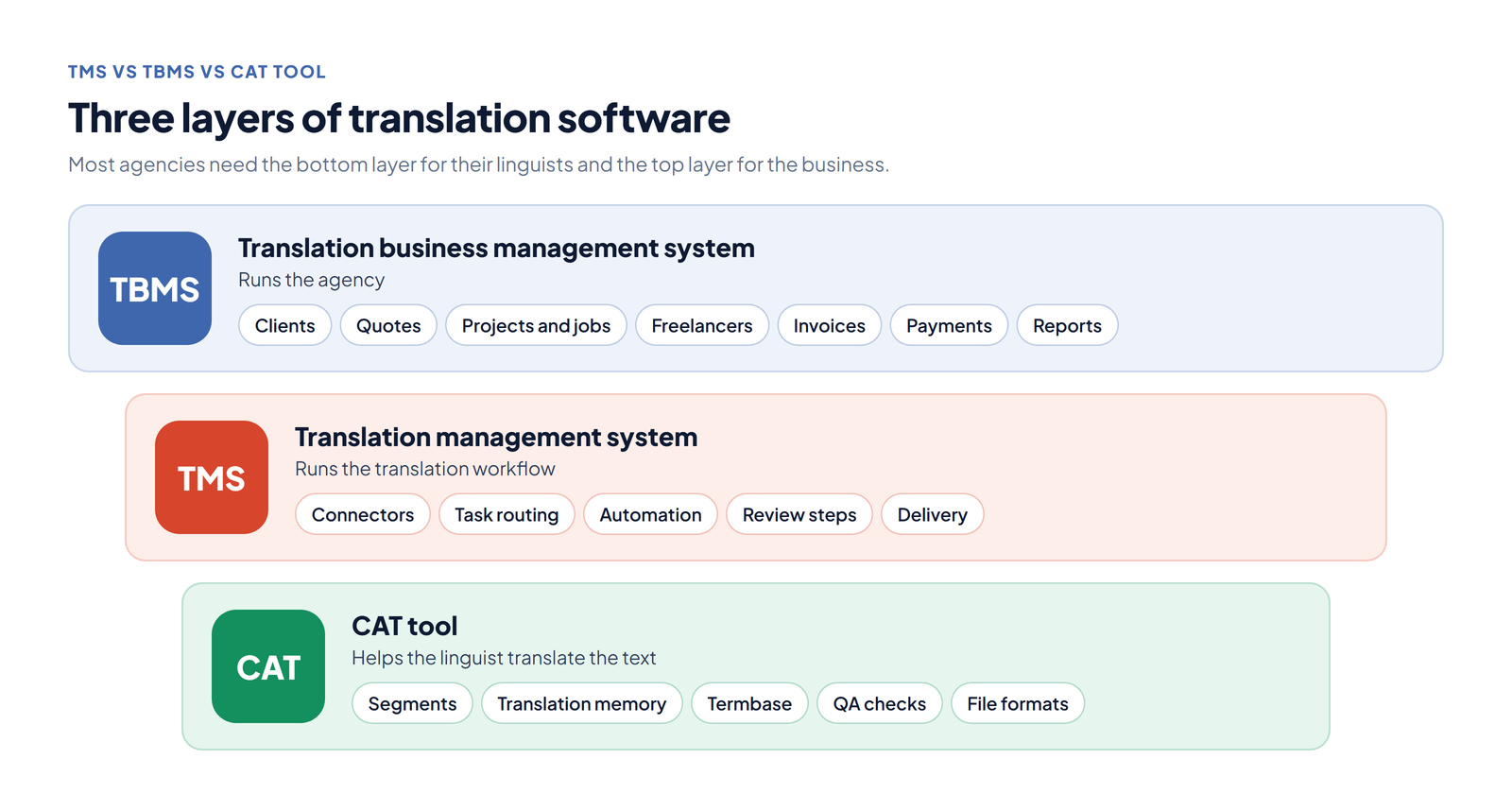
Ask three vendors what a "translation management system" is and you'll get three different products. One will show you an editor with a translation memory. Another will show you connectors to a client's website and a workflow that routes files between translators. The third will show you clients, quotes, invoices and freelancer payments.
They're all describing real software. They're just describing different layers of the same work, and if you're buying for an agency, mixing them up is expensive: you can sit through a polished demo of something that solves a problem you don't have.
Here's how the three categories differ, where they overlap, and which ones an agency actually needs.
What is a CAT tool?
A CAT tool (computer-assisted translation) is where the translating happens. It splits a document into segments, shows the source next to the target, and offers matches from a translation memory and terms from a termbase as the linguist works. When the job is done, it rebuilds the file in its original format.
The point of a CAT tool is consistency and speed for the person doing the translation. Trados Studio and memoQ are the names most freelancers know, and most agencies receive work back from linguists through one of them.
A CAT tool doesn't know who the client is, what you quoted, or whether the job has been invoiced. It isn't meant to.
What is a translation management system (TMS)?
A TMS manages the translation workflow around the text: which files need translating, who works on them, in what order, and when they're done. Good ones connect straight into the systems where the content lives (a website, an app, a document library), pull new text out automatically, and push translations back in.
TMS platforms are built mostly for continuous localisation: a company that ships website and product updates every week in fifteen languages. That's why the top search results for "translation management system" are full of localisation platforms. They're excellent at that job. Many include a cloud CAT editor, so the line between TMS and CAT tool is blurry.
What is a translation business management system (TBMS)?
A TBMS runs the agency itself. It's sometimes called translation agency management software, or business management software for language service providers. It covers the work that happens before and after the translation:
- enquiries and quotes, including word counts and minimum charges
- clients, contacts and their price agreements
- projects, jobs, deadlines and who is doing what
- the freelancer database: languages, specialisms, rates, availability
- invoices, payments received and chasing what's overdue
- paying the linguists
- reports on margin, volume and late work
If your day is spent on emails like "can you quote this by tomorrow?", "who's free for Polish on Thursday?" and "has the Harbour Legal invoice gone out?", the software you're missing is a TBMS, not another translation tool.
How they compare
| CAT tool | TMS | TBMS | |
|---|---|---|---|
| What it manages | The text and its segments | The translation workflow | The agency's business |
| Main users | Translators and revisers | Localisation managers | Project managers, sales, accounts |
| Typical buyer | Freelancers and agencies | Companies with constant content updates | Translation and interpreting agencies |
| Core features | Translation memory, termbase, QA, file formats | Connectors, task routing, automation | Quotes, jobs, vendors, invoices, payments, reports |
| Usually priced | Per licence | By volume or platform fee | Per user or per manager |
Where the lines blur
Most products now reach into the layer next door. TMS platforms add vendor management and invoicing. TBMS products add an editor and a translation memory so that small jobs never need to leave the system. AI has blurred things further, because a first draft can now be produced inside whichever system holds the file.
That's not a problem, as long as you know which layer a product was built for. A tool that started life as a CAT tool will treat invoicing as an afterthought, and a business system that bolted on an editor won't replace a seasoned translator's CAT tool for a 40,000-word technical manual. Ask vendors what the product was originally built to do. The answer tells you where it's strongest.
In LinguisTriks, for example, the core is the agency's business: enquiries, quotes, bookings, projects, linguists, invoicing and payouts. It also has a bilingual editor with translation memory, glossary and QA checks for reviewing AI first drafts, and it exchanges XLIFF files with CAT tools, so linguists who prefer Trados Studio or memoQ can keep using them.
Which one does your agency need?
It depends far more on how you work than on how big you are.
A freelancer or a two-person agency needs a CAT tool and something simple to track jobs and invoices. A spreadsheet works until it doesn't, which is usually the first time two people quote the same client on the same day.
A growing agency with a team of project managers needs a TBMS. This is the stage where work falls between the cracks: a job nobody assigned, a completed project nobody invoiced, a linguist paid twice because two people saw the same request. Your linguists keep their CAT tools.
An agency that also books interpreters needs a TBMS that handles bookings as well as translation projects, or you'll end up running two systems, two client lists and two invoice runs.
An agency running continuous localisation for software or e-commerce clients needs a TMS with the right connectors as well as its business system. That's the point where the localisation platforms earn their price.
What project management software for translation agencies should do
"Project management" is where agency owners usually start their search, so it's worth being specific. Generic project tools (boards, cards, Gantt charts) don't know what a word count, a target language or a certified translation is. Whatever you choose, check it can do these things without workarounds:
- Create a project with several jobs, each with its own languages, service, deadline and linguist
- Hold the source and translated files against the job, not in a shared drive
- Show each linguist only their own jobs, through a portal rather than email
- Flag what's due today, what's late and what's finished but not invoiced
- Keep the client's price, the linguist's cost and the margin on the same job
- Turn an accepted quote into a project without re-typing it
- Produce certificates and declarations for certified work
The third and fourth points are the ones that save the most time in practice. A list that tells a project manager "these three things need you today" beats any amount of colour-coded board.
Questions to ask in a demo
- What was the product originally built to do?
- Can you show a quote becoming a project, then an invoice, then a linguist payment, without leaving the system?
- How do linguists receive work, and do they need a licence or an app?
- How does it work with the CAT tools our linguists already use?
- What happens when a job is late or nobody has been assigned?
- Is the price published, and what's included?
If the demo can't follow one job from enquiry to payment, you're probably looking at a different layer from the one you need.
The short version
Your linguists need a CAT tool. Your agency needs a business system. A TMS earns its place when you have clients with a constant stream of content to localise. Buy each one for what it was built to do and you'll spend less, and switch less often.
If you'd like to see the business layer working on your own jobs, LinguisTriks for translation agencies has a free trial with every feature, and the pricing is published.
Frequently asked questions
Is a TMS the same as a CAT tool?
No. A CAT tool is where a linguist translates, with translation memory, a termbase and QA checks. A TMS manages the workflow around the translation: which files need translating, who works on them and when. Many TMS platforms include a CAT editor, which is why the two are often confused.
What does TBMS stand for?
Translation business management system: software that runs the business side of a translation agency, such as clients, quotes, projects, freelancers, invoices, payments and reports. It's also called translation agency management software.
Do I need a TMS if my linguists already use Trados or memoQ?
Usually not. Most agencies need a CAT tool for their linguists and a business system for the agency. A TMS matters when clients send a constant stream of content that needs connectors and automated workflows.
What is translation project management software?
Software for running translation projects: creating jobs with languages and deadlines, assigning linguists, holding the files, tracking status and flagging what's late. In most agencies it's part of the business management system rather than a separate tool.
Can one system do all three?
Some products reach into all three layers, but each is usually strongest at what it was first built for. Ask a vendor what the product was originally designed to do, and check it works with the CAT tools your linguists already use.
Related articles
Interpreter Scheduling Software: A Buyer's Checklist for Agencies
Good interpreter scheduling software books onsite, phone and video jobs in one place and fills them quickly with email and SMS offers. It gives clients and linguists self-service portals and turns completed jobs into invoices and payouts without re-keying. It also keeps your data secure and auditable. This checklist shows what to test before you buy.
Read article
How to price translation services: a margin model for agencies
Price translation from what a job really costs you - the translator, revision, project management time, certification and payment fees - then add the margin you need and express it as a rate the client understands. Charge per word for most documents, per document for certificates and short standard documents, per hour for editing and DTP, and always set a minimum charge.
Read article
Interpreter cancellation policy: a template for agencies
A good interpreter cancellation policy sets notice periods and fees (for example, free with 48 hours' notice, half the fee inside 48 hours and the full fee inside 24 hours), says what the interpreter is paid, covers no-shows on both sides and remote sessions, and is agreed in writing before the first booking. The template below is a starting point to adapt with your own terms and legal advice.
Read article